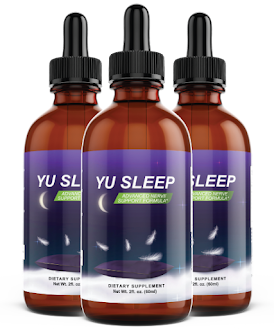
Yu Sleep Ingredients: What's in Each Dropper and How It Works
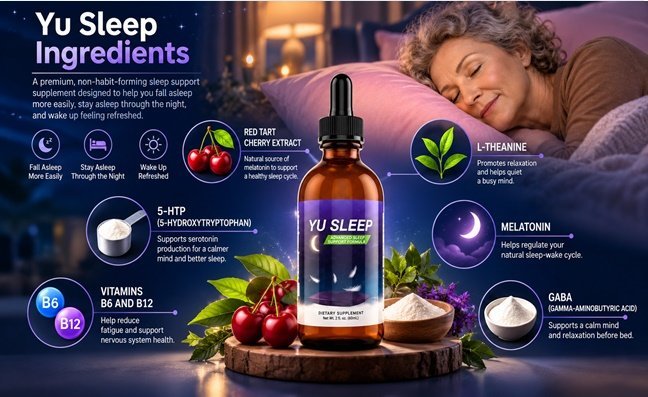
Yu Sleep's formula is built around six ingredients that work on two sides of sleep: calming a busy mind and telling your body that it is night. This page breaks down each one, what it does, how much research supports it, and what to check on the Supplement Facts label before you take it.
Last updated: October 2026
Yu Sleep ingredient list at a glance
The table below summarizes the main ingredients highlighted by the brand. "Amounts used in studies" refers to published research on each ingredient on its own, not to the amount in Yu Sleep. The exact amounts per serving are printed on the label further down this page.
| Ingredient | Main role | Amounts used in studies | Evidence |
|---|---|---|---|
| Melatonin | Signals night to the body clock | 0.5 to 5 mg | Strong |
| L-theanine | Relaxation without sedation | 200 to 400 mg | Moderate |
| Tart cherry | Natural source of melatonin | Juice or concentrate, twice daily | Moderate |
| GABA | Calming neurotransmitter | 100 to 300 mg | Limited |
| 5-HTP | Precursor to serotonin and melatonin | 50 to 300 mg | Limited |
| B vitamins | Help convert 5-HTP into serotonin | Around daily recommended amounts | Supporting |
How the ingredients fit together
The formula follows two paths at the same time. One supports the body's own chain for making melatonin. The other targets the stress and mental chatter that keep many people awake.
Path 1: the melatonin chain
- 5-HTPbuilding block
- Serotoninmade with help from vitamin B6
- Melatonintopped up by melatonin and tart cherry
- Sleep signalbody clock shifts to "night"
Path 2: calming the mind
- GABAthe brain's main "slow down" signal
- L-theanineeases stress, supports alpha brain waves
- Quieter mindeasier to drift off
Melatonin
Melatonin is a hormone made by the pineal gland in your brain. Its levels rise in the evening as light fades and fall in the morning, which helps set your internal 24-hour clock. It does not work like a sedative. Instead, it tells your body that it is time to prepare for sleep.
What the research says: Melatonin is the most studied ingredient in Yu Sleep. Reviews of clinical trials show it can shorten the time it takes to fall asleep and slightly increase total sleep time, with the clearest benefits for jet lag and delayed sleep schedules. Studies also suggest that low doses, often 0.5 to 1 mg, can work as well as higher ones for many people.
Why it matters in Yu Sleep: The brand positions Yu Sleep as an alternative to "high-dose melatonin." Pairing a modest dose with other ingredients is a reasonable way to reduce next-day grogginess, which is more common at higher doses.
L-theanine
L-theanine is an amino acid found mainly in green and black tea. It is the reason tea can feel calming even though it contains caffeine. It is associated with alpha brain waves, which are linked to a relaxed but alert state.
What the research says: In a four-week trial in healthy adults, 200 mg of L-theanine per day improved self-reported sleep quality and reduced stress-related symptoms compared with placebo. Other small studies show similar effects on relaxation. It does not make you drowsy on its own, which is why it is often used for stress-related sleep problems.
Why it matters in Yu Sleep: L-theanine targets the "racing mind" that many people describe at bedtime, rather than the body clock.
Tart cherry
Tart cherry, especially the Montmorency variety, is one of the few foods that naturally contains melatonin. It is also rich in polyphenols and contains small amounts of tryptophan, the amino acid that the body turns into 5-HTP.
What the research says: Small trials using tart cherry juice found increases in melatonin levels, total sleep time and sleep efficiency in adults. One study in older adults with insomnia reported more than an hour of extra sleep per night with tart cherry juice compared with placebo. The studies are promising but small, and most used juice or concentrate rather than drops.
Why it matters in Yu Sleep: Tart cherry adds a whole-food source of melatonin alongside the added melatonin, which fits the "plant-based" positioning of the formula.
GABA
GABA (gamma-aminobutyric acid) is the brain's main inhibitory neurotransmitter. It slows down nerve activity, which is why many prescription sleep and anxiety medicines work by boosting GABA's effects.
What the research says: Whether GABA taken by mouth reaches the brain in meaningful amounts is still debated, since it may not cross the blood-brain barrier easily. Even so, a few small human studies report shorter time to fall asleep and improved relaxation, possibly through effects on the gut-brain connection. Larger trials are needed.
Why it matters in Yu Sleep: GABA supports the "calming" side of the formula, alongside L-theanine.
5-HTP
5-HTP (5-hydroxytryptophan) is a compound your body makes from tryptophan. It is converted into serotonin, which in turn is converted into melatonin at night. Supplemental 5-HTP is usually extracted from the seeds of the African plant Griffonia simplicifolia.
What the research says: 5-HTP has been studied mainly for mood. Direct sleep studies are few and small, although some research suggests it may work better when combined with GABA. The bigger issue is safety: because it raises serotonin, it should not be combined with antidepressants or other serotonin-affecting medicines without medical advice.
Why it matters in Yu Sleep: 5-HTP gives the body raw material for its own melatonin production, rather than relying only on added melatonin.
B vitamins
B vitamins, particularly vitamin B6, act as helpers (cofactors) for the enzymes that convert 5-HTP into serotonin. They also support normal nervous system function and energy metabolism.
What the research says: B vitamins are not sleep aids on their own, and there is little evidence that extra B vitamins improve sleep in people who are not deficient. Their role in Yu Sleep is supportive: making sure the conversion steps in the melatonin chain are not held back.
Why it matters in Yu Sleep: They complete the 5-HTP to serotonin to melatonin pathway described above.
What "nano-enhanced" liquid means
Yu Sleep is sold as drops rather than capsules. The brand says the ingredients are "nano-enhanced," meaning they are processed into very small particles intended to absorb faster and more completely.
Liquids generally do not need to dissolve first, so a faster onset is plausible. However, we have not seen independent data measuring how Yu Sleep's absorption compares with ordinary liquid or tablet supplements. Treat "nano-enhanced" as a description of the manufacturing approach, not as proof of better results.
A practical benefit of drops is flexibility: it is easy to start with a smaller serving and adjust, within the limits on the label.
Ingredient safety notes
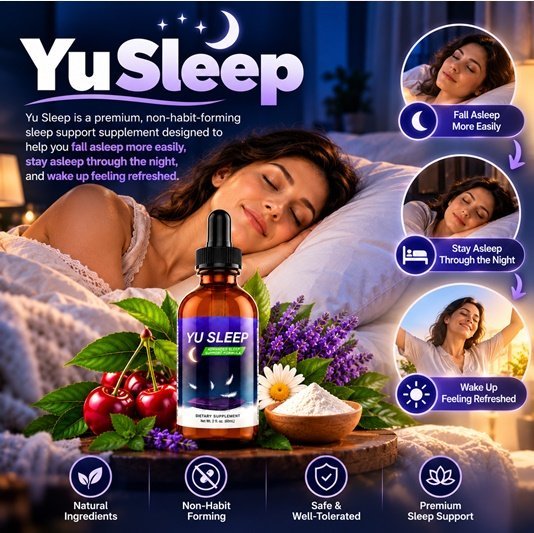
Each ingredient is widely used and generally well tolerated by healthy adults. A few ingredient-specific points are worth knowing:
- Melatonin can cause morning drowsiness, headache or vivid dreams, and may interact with blood thinners, blood pressure and diabetes medicines.
- 5-HTP should not be combined with antidepressants (SSRIs, SNRIs, MAOIs), triptans or other serotonin-affecting drugs without a doctor's approval.
- GABA and L-theanine may add to the effect of sedatives or blood pressure medicines.
- Pregnancy and breastfeeding: there is not enough safety data for this combination, so it is best avoided.
For a complete list of possible side effects and interactions, see our Yu Sleep side effects guide.
How to read the Yu Sleep Supplement Facts label
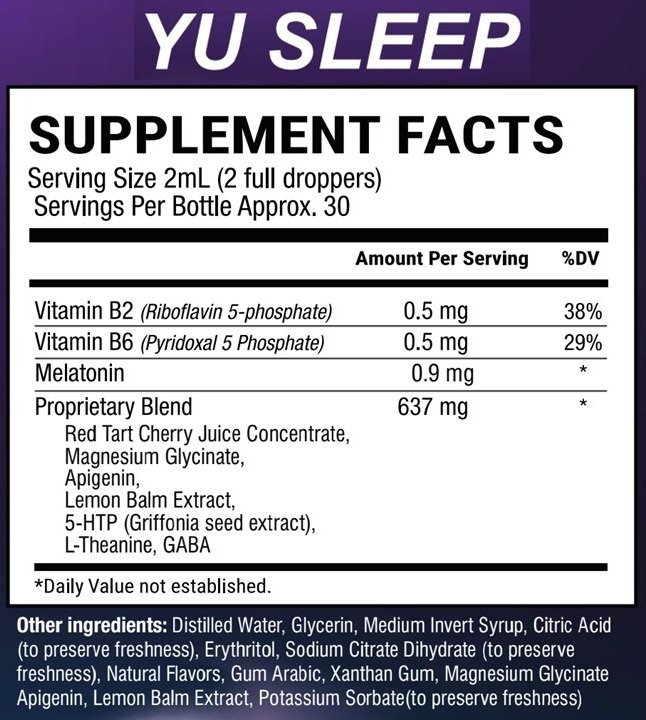
The label is the only reliable source for what is in the bottle you receive. When you look at it, check:
- Serving size: how many drops or droppers count as one serving, and how many servings are in the bottle.
- Individual amounts: especially melatonin and 5-HTP, which matter most for safety and interactions.
- Proprietary blend: if several ingredients are grouped as a "blend," only the total weight is listed, not each ingredient's amount.
- Other ingredients: the liquid base, flavors and sweeteners, useful if you have allergies.
- Warnings: age limits and advice about pregnancy, medication and driving.
Take a photo of the label to your doctor or pharmacist if you take any regular medication.
Questions about Yu Sleep ingredients
Does Yu Sleep contain melatonin?
Yes. Melatonin is one of the core ingredients, combined with tart cherry, which naturally contains small amounts of melatonin. Check the label for the exact dose per serving.
Are Yu Sleep's ingredients natural?
Most are naturally occurring compounds or plant extracts: L-theanine from tea, 5-HTP from Griffonia seeds and tart cherry from fruit. Melatonin in supplements is usually produced synthetically, even though it is identical to the hormone your body makes.
Does Yu Sleep contain antihistamines like diphenhydramine?
Antihistamines are not among the ingredients highlighted by the brand. Many over-the-counter sleep aids rely on diphenhydramine or doxylamine, which can cause stronger next-day grogginess. Always confirm with the label.
Which Yu Sleep ingredient has the strongest evidence?
Melatonin, followed by L-theanine and tart cherry. GABA and 5-HTP have more limited direct evidence for sleep.
Can the ingredients cause dependence?
None of the ingredients are known to be addictive in the way some prescription sleep medicines can be. Using any sleep aid every night can still become a habit, so it helps to pair it with good sleep routines.
The takeaway on Yu Sleep's formula
Yu Sleep combines a well-studied core (melatonin, L-theanine, tart cherry) with supporting ingredients that have more limited evidence (GABA, 5-HTP, B vitamins). The logic of the formula is sound, and the main safety question is 5-HTP for anyone on medication.
To see how the formula performs in practice, read our Yu Sleep review, or go back to the Yu Sleep guide for prices and how to use it.